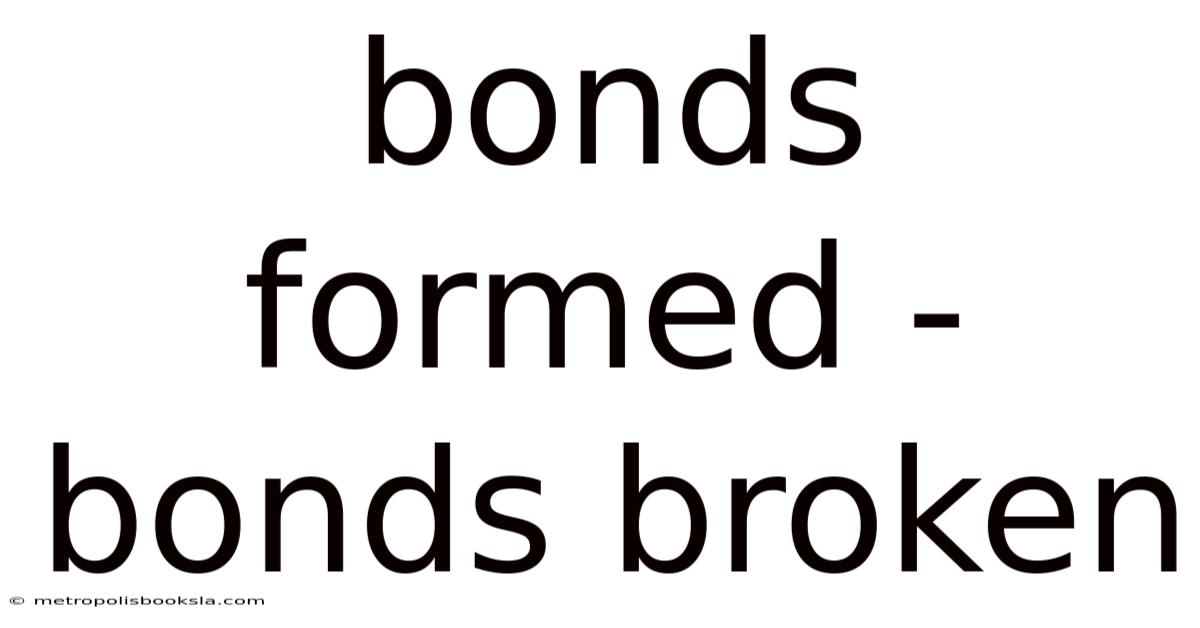
Bonds Formed, Bonds Broken: A Journey into Chemical Bonding and Reactions
Chemical reactions are the heart of chemistry, the dynamic processes that shape our world. Understanding these fundamental processes is key to unlocking a deeper understanding of everything from the rusting of iron to the complexities of life itself. At their core, these reactions involve the breaking and forming of chemical bonds – the forces that hold atoms together to create molecules and compounds. This article will look at the fascinating world of chemical bonding, exploring the different types of bonds, the factors influencing their formation and breakage, and the energy changes involved in these transformative events Small thing, real impact..
Introduction: The Dance of Atoms
Atoms, the fundamental building blocks of matter, rarely exist in isolation. They are driven by a fundamental desire for stability, often achieved by interacting with other atoms to form chemical bonds. These bonds arise from the electrostatic forces between atoms, primarily involving the interactions of their outermost electrons, known as valence electrons. The strength and type of bond formed depend on the properties of the atoms involved, specifically their electronegativity – the tendency of an atom to attract electrons towards itself in a chemical bond.
This dance of atoms, the making and breaking of bonds, is what fuels chemical reactions. Reactions can be as simple as the combination of two elements to form a compound, or incredibly complex, involving multiple steps and the rearrangement of numerous atoms. But regardless of their complexity, all chemical reactions boil down to this fundamental principle: bonds are broken in the reactants, and new bonds are formed in the products.
Types of Chemical Bonds: A Closer Look
Several types of chemical bonds exist, each with its unique characteristics and implications for the properties of the resulting molecules. The most common types are:
1. Ionic Bonds: These bonds form through the electrostatic attraction between oppositely charged ions. This typically occurs when a metal atom, which readily loses electrons, interacts with a non-metal atom, which readily gains electrons. The metal atom loses one or more electrons to become a positively charged cation, while the non-metal atom gains those electrons to become a negatively charged anion. The strong electrostatic attraction between these ions forms the ionic bond. Examples include sodium chloride (NaCl) and magnesium oxide (MgO).
2. Covalent Bonds: In covalent bonds, atoms share electrons to achieve a stable electron configuration. This typically occurs between non-metal atoms, which have similar electronegativities. The shared electrons are attracted to the nuclei of both atoms, creating a bond that holds them together. Covalent bonds can be polar (if the electrons are shared unequally due to a difference in electronegativity between the atoms) or non-polar (if the electrons are shared equally). Examples include methane (CH₄) and water (H₂O).
3. Metallic Bonds: Metallic bonds occur in metals, where valence electrons are delocalized and move freely throughout the metal lattice. This creates a "sea" of electrons that holds the positively charged metal ions together. This explains the characteristic properties of metals, such as their high electrical and thermal conductivity, malleability, and ductility.
4. Hydrogen Bonds: While not a true chemical bond in the same sense as ionic or covalent bonds, hydrogen bonds are strong intermolecular forces that occur between a hydrogen atom bonded to a highly electronegative atom (like oxygen, nitrogen, or fluorine) and another highly electronegative atom in a different molecule. These bonds are crucial for many biological processes, such as the structure of proteins and DNA And that's really what it comes down to. That alone is useful..
Bond Energy: The Strength of the Connection
The strength of a chemical bond is measured by its bond energy, which is the energy required to break one mole of a particular type of bond in the gaseous state. Also, stronger bonds have higher bond energies, indicating that more energy is required to break them. Bond energy is crucial in determining the reactivity of a molecule and the energy changes that accompany chemical reactions. As an example, a molecule with weak bonds is more likely to react than a molecule with strong bonds.
Factors Affecting Bond Formation and Breakage
Several factors influence the formation and breaking of chemical bonds:
-
Electronegativity: As mentioned earlier, the difference in electronegativity between atoms significantly impacts the type and strength of the bond formed. A large difference leads to ionic bonds, while a small difference leads to covalent bonds.
-
Atomic Size: Larger atoms generally form weaker bonds due to increased distance between the nuclei and valence electrons.
-
Bond Order: The bond order (the number of bonds between two atoms) affects bond strength. Double bonds (bond order = 2) are stronger than single bonds (bond order = 1), and triple bonds (bond order = 3) are even stronger.
-
Temperature: Higher temperatures generally provide the energy needed to break bonds, facilitating chemical reactions.
-
Pressure: Pressure can influence bond formation and breakage, particularly in reactions involving gases.
Chemical Reactions: Bonds in Motion
Chemical reactions are essentially the rearrangement of atoms through the breaking and forming of chemical bonds. In a reaction, the reactants (starting materials) have certain bonds broken, and new bonds are formed in the products (resulting materials). This process is governed by the principles of thermodynamics and kinetics.
-
Thermodynamics: This branch of chemistry deals with the energy changes accompanying chemical reactions. Reactions that release energy (exothermic reactions) are generally favored, while reactions that require energy input (endothermic reactions) are less likely to occur spontaneously.
-
Kinetics: This branch of chemistry examines the rates of chemical reactions and the factors that affect them. The rate of a reaction depends on factors such as the concentration of reactants, temperature, and the presence of catalysts And that's really what it comes down to..
Energy Changes in Chemical Reactions
Chemical reactions are always accompanied by energy changes. In real terms, exothermic reactions release energy to the surroundings, usually in the form of heat or light. And endothermic reactions absorb energy from the surroundings. The energy change in a reaction is related to the difference in bond energies between the reactants and the products. On the flip side, if the energy required to break the bonds in the reactants is less than the energy released when new bonds are formed in the products, the reaction is exothermic. Conversely, if the energy required to break the bonds in the reactants is greater than the energy released when new bonds are formed in the products, the reaction is endothermic.
Illustrative Examples: Breaking and Making Bonds
Let's consider a simple example: the combustion of methane (CH₄). In this reaction, methane reacts with oxygen (O₂) to produce carbon dioxide (CO₂) and water (H₂O):
CH₄ + 2O₂ → CO₂ + 2H₂O
In this reaction:
- Bonds Broken: The C-H bonds in methane and the O=O bonds in oxygen are broken.
- Bonds Formed: The C=O bonds in carbon dioxide and the O-H bonds in water are formed.
The energy released during the formation of the new bonds is greater than the energy required to break the existing bonds, making this reaction highly exothermic Not complicated — just consistent. Which is the point..
Applications of Bond Formation and Breakage
The principles of bond formation and breakage are fundamental to numerous applications across various fields:
-
Material Science: Understanding how bonds form and break allows for the design and synthesis of new materials with specific properties, such as strength, conductivity, and reactivity The details matter here..
-
Medicine: Drug design and development rely heavily on understanding how molecules interact with each other through bond formation and breakage. Many drugs work by inhibiting or activating specific enzymes by interacting with their active sites through bond formation.
-
Environmental Science: Understanding chemical reactions and bond formation is crucial for studying environmental processes, such as pollution control and the carbon cycle.
Frequently Asked Questions (FAQ)
Q: What is the difference between a strong and a weak bond?
A: A strong bond requires a significant amount of energy to break, while a weak bond requires less energy. Strength is related to bond energy and factors such as bond order and electronegativity differences.
Q: Can bonds be broken at room temperature?
A: Yes, some bonds are relatively weak and can be broken at room temperature. Still, many bonds require higher temperatures or the presence of a catalyst to break.
Q: How do catalysts affect bond formation and breakage?
A: Catalysts provide an alternative reaction pathway with a lower activation energy, making it easier to break and form bonds, thus speeding up the reaction rate. They do not get consumed in the reaction.
Conclusion: A Dynamic Equilibrium
The formation and breakage of chemical bonds are dynamic processes that govern the world around us. Day to day, understanding the different types of bonds, their strengths, and the factors that influence their formation and breakage is crucial for comprehending a wide range of phenomena, from material properties to biological processes. Worth adding: from the simplest chemical reactions to the complexities of life itself, these processes are at the heart of chemistry. The ongoing research into chemical bonding continues to unveil new insights, paving the way for advancements in various scientific and technological fields. The dance of atoms, the making and breaking of bonds, is a continuous process, a dynamic equilibrium that shapes our reality.
